

Schedule of Events
Here is the schedule of events for the BloomCon26 In-Person Conference on October 1-4 in Dallas Texas!
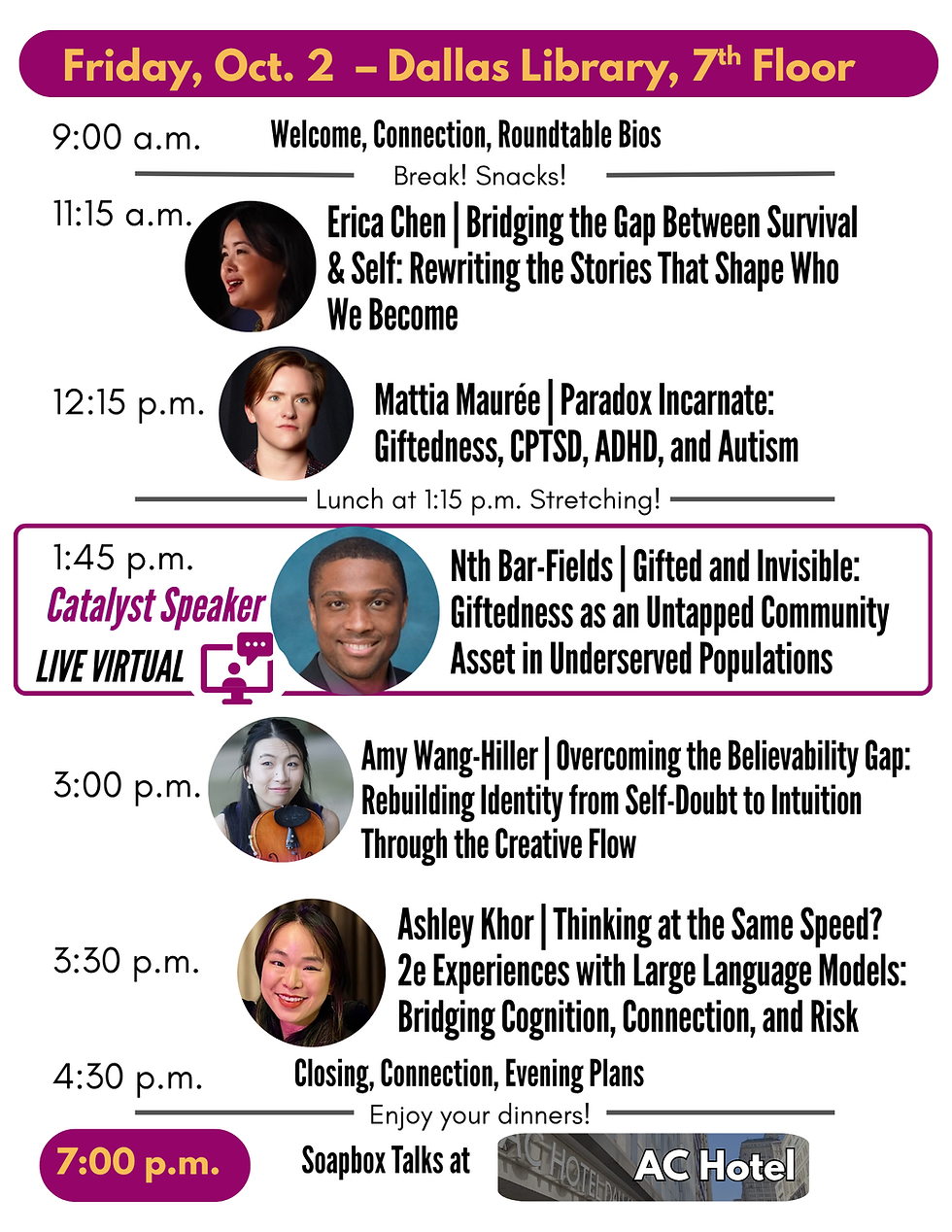


age


Presenters & Sessions
Dedication. Expertise. Passion.
Each presenter brings a wealth of personal and professional background to the BloomCon Experience! Check out their session descriptions here!

Title: Reimagining Educational Justice In the Face of Opposition Our First catalyst speaker, Dr. Altheria Caldera will be discussing her newly released book and the topic of reimagining educational justice, a topic that extends into all lives. Dr. Caldera is advancing urgent, actionable pathways for protecting and transforming educational equity.
Educator, activist, and national DEIB leader with over 20 years of classroom impact, Dr. Caldera brings bold insight at the intersection of education, justice, and community change. Author of the newly released Reimagining Educational Justice in the Face of Opposition (2026), she is advancing urgent, actionable pathways for protecting and transforming educational equity.

Gifted and Invisible: Giftedness as an Untapped Community Asset in Underserved Populations What if giftedness isn't a privilege marker, but a community resource? Nth Bar-Fields challenges the assumption that intellectual giftedness belongs primarily to well-resourced, majority populations — arguing instead that it goes catastrophically unrecognized in BIPOC, low-income, and otherwise marginalized communities, where it's too often filtered out by systems never built to see it. Drawing on years of grant-funded social venture work and a nexialist's ability to connect across disciplines, Nth reframes giftedness identification as an equity issue: not just who gets support, but what talent entire communities lose when it stays invisible.
Nth Bar-Fields is Founder and Chief Visionary Officer of Elysian Trust, a social venture firm that has secured over $55 million in grants supporting neurodivergent and gifted individuals, with a focus on underserved communities. A Research Fellow at TANDO Institute and author of Hoodoo for Dummies (Wiley, 2026), Nth integrates ancestral knowledge with rigorous research. As a nexialist, their work reframes giftedness as a community resource often overlooked in BIPOC and low-income populations. Nth identifies as African-American and LGBTQIA2S+.

Title: Overcoming the Believability Gap: Rebuilding Identity from Self-Doubt to Intuition Through the Creative Flow What happens to the identity when the systems that are supposed to support us deny the physical reality? The continuous misdiagnosis or systemic disbelief neurodivergent folks face creates a deep “believability gap” — a space where external gaslighting fuels internal self-doubt and imposter syndrome. It’s a personal journey of deconstructing that doubt and reclaiming radical bodily intuition. Drawing from my perspective as a doctoral student in violin performance, navigating complex neuro-connective tissue failure after years of psychiatric misdiagnosis, we will discuss how the creative mind can be a tool for survival but also a weapon used to disbelieve us. We will discuss how to enter a state of creative flow that allows us to be present in the moment, to trust our internal data and to rebuild from a shattered identity, transforming personal survival into a collective community framework for systemic societal change.
Amy Wang-Hiller is a violinist, educator, and arts leader based in Denton, Texas, whose work unites artistic excellence with disability inclusion. As Founder and Executive Director of InclusiVibe Foundation and Founder of Wang-Hiller LLC, she builds disability-led programs at the intersection of music, healthcare, and community. A violin and viola teacher for over 17 years, she holds a Master of Music from LSU and pursues doctoral study at the University of North Texas, with performance experience spanning orchestral, chamber, and solo work in the U.S. and China.

Exploring Theories on the Link Between 2E and LGBTQIA+ Identities Why do twice-exceptional and LGBTQIA+ identities show up together so often? Rhya Krellwitz — identified as gifted young, then formally diagnosed with ADHD and informally with autism after burning out during the pandemic — brings both lived experience and genuine curiosity to this question. Drawing on personal reflection and a wider interest in the research, Rhya explores possible explanations for the overlap between neurodivergent-gifted and queer identities: shared experiences of masking, difference, and self-discovery. This session is an invitation to untangle the threads together, for anyone who's noticed the pattern in their own life or community.
Rhya, known to many in conference spaces as Caleb, was identified as gifted early and excelled academically until experiencing burnout during the pandemic. Since then, Rhya has been formally diagnosed with ADHD and informally with autism. After attending SENG 2023, Rhya found a sense of belonging and returned in 2024 and for BloomCon 2025. With a strong interest in understanding twice-exceptionality, Rhya hopes to become a counselor supporting 2E teens and young adults.

Bridging the Gap Through Fortification: Mapping 2e Intensities with Awareness, Recognition, and Tailoring (ART) Twice-exceptional adults often carry a level of intensity that standard wellness advice was never built for. In this session, Summer Esquerre introduces the Intensity Map, a somatic tool for identifying what drains your energy, what actually supports your capacity, and what needs to change to make room for both. Using the ART framework — Awareness, Recognition, and Tailoring — Summer guides participants toward practical, body-based strategies for protecting their energy and setting boundaries that fit who they really are. Grounded in nervous-system awareness, this is fortification you can put into practice immediately, not abstract theory.
Summer Esquerre is the co-founder of SMART Wellness and a somatic leadership coach. She supports high-achieving professionals through a lens shaped by Black queer and twice-exceptional lived experience. Her work brings the SMART Wellness Framework into practical application, helping people protect their energy, set boundaries, and build support that aligns with who they are, while guiding organizations to create conditions where gifted and intense individuals can thrive without burnout.

Thinking at the Same Speed? 2e Experiences with Large Language Models For many gifted and twice-exceptional adults, conversing with an LLM can feel different — faster, more patient, less socially costly than talking with people. But what does that actually mean? In this workshop, Ashley Khor draws on her PhD research in public policy and AI to explore how large language models are reshaping cognition, connection, and risk for neurodivergent and 2e individuals. Participants will examine where these tools offer real support — reflection, processing, reduced friction — and where they introduce new vulnerabilities, from over-reliance to isolation, grounded in both technical understanding and lived experience.
Ashley Khor is a PhD candidate in public policy and AI focused on translating responsible AI into practice. With over a decade in applied data science and public-sector innovation, she studies how generative AI operates in high-stakes, real-world settings, especially within social impact organizations. Her work emphasizes sociotechnical approaches that integrate technical capability with human values, lived experience, and institutional constraints. She brings a sustained interest in cognitive diversity, exploring how large language models may shape connection, reflection, and risk for neurodivergent and twice-exceptional (2e) individuals.

Understanding the Gap Between Simplistic Labels and Complex Identities Labels can be useful shorthand — and they can also flatten a person into something far simpler than who they actually are. Drawing on her background as a scientist and her experience parenting twice-exceptional emerging adults, Erin Krellwitz explores the space between the diagnostic or identity labels people carry and the full, layered reality underneath them. This session digs into why complex identities so often get compressed into single words, what gets lost in that compression, and how to hold both the usefulness of labels and the fuller truth of the person wearing them — for yourself or for someone you support.
Erin Krellwitz earned a PhD in botany at Duke University, developed science education materials for Carolina Biological Supply, and assisted a photographer in his small business. Erin is parenting twice-exceptional (2e) emerging adults in a complicated world. She brings that experience to her work as a life coach with a focus on neurodiversity and a love for helping people figure out what they want in their life. Learn more about Erin at mossandmaplecoaching.com!

Bridging the Gap Between Survival and Self: Rewriting the Stories That Shape Who We Become We all carry stories we didn't write ourselves — inherited narratives about who we should be, what success looks like, and what it costs to belong. Erica Chen explores the gap between the survival strategies that got us here and the self that's still waiting to be fully known. Drawing on 15 years across corporate environments and her work with mothers and first- and second-generation women, Erica uses her Pivot & Shimmy framework to help participants recognize the inherited stories driving their choices — and begin rewriting them into something more aligned with who they actually are.
Erica Chen is a leadership speaker, community strategist, and co-founder of Super Impactful, where she supports the development of self-aware, human-centered cultures. Drawing from 15 years in corporate environments, including WeWork, Groupon, and Bank of America, alongside her work with mothers and first- and second-generation women, she examines how inherited narratives shape identity, burnout, and leadership. Her framework, Pivot & Shimmy, integrates storytelling with practical tools to support meaningful, aligned shifts. As founder of Unicorn Dynasty, she creates spaces where lived experience, healing, and leadership intersect.

Bridging the Gap Between How We Work and How We're Understood: Creating Personal User Guides for Neurodiverse Teams Most workplace friction isn't about ability — it's about misunderstanding how people actually think, communicate, and work best. Erica Chen and Jeff Gibbard introduce their "User Guide" framework, a practical tool for articulating your own needs, preferences, and working style so teammates don't have to guess. Drawing on Jeff's lived experience as a neurodivergent entrepreneur and Erica's background in leadership and culture strategy, this session walks neurodiverse teams through building personal user guides that foster clarity, empathy, and more inclusive collaboration — turning "how we're different" into something teams can actually work with.
Jeff Gibbard, a neurodivergent author, entrepreneur, and speaker, focuses on helping individuals and teams deepen self-awareness, improve communication, and build more effective, aligned systems. Together with Erica Chen, he integrates lived experience with practical tools, supporting organizations in developing cultures rooted in clarity, inclusion, and connection. Their work centers on helping people understand how they think, relate, and lead, creating environments where individuals and teams can engage more authentically and function more effectively.
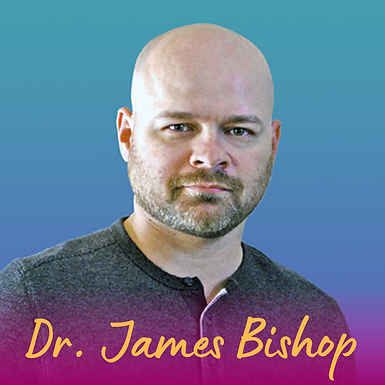
Gifted… and Complicated: The Funniest Things I've Learned Studying Bright Minds Studying giftedness for a living means encountering plenty of absurdity along the way — and Dr. James Bishop has collected the best of it. In this talk, he bridges outdated pathology-based paradigms with a more current, developmental understanding of what giftedness actually is, using humor as the entry point rather than the footnote. Drawing on years as an educational psychologist and licensed counselor working with gifted individuals, James shares the funniest, most human moments from his research and practice, using them to illuminate real insights about how bright minds actually develop, struggle, and thrive.
James Bishop developed an interest in giftedness after watching a film about martial artist Bruce Lee. But after several years of studying martial arts and getting kicked in the head repeatedly, Bishop decided that what he really admired about Lee was his brilliant mind. This realization led him to leave the fighting cage and pursue graduate study in counseling, followed by a PhD in educational psychology with a focus on giftedness and talent. Dr. Bishop is an educational psychologist, licensed professional counselor, and author whose work focuses on the social and emotional development of gifted individuals.

Paradox Incarnate: Giftedness, CPTSD, ADHD, and Autism What happens when giftedness, trauma, ADHD, and autism all show up in the same person at once? Mattia Maurée explores that paradox from the inside out — as someone whose early identification as gifted masked autism and ADHD discoveries until adulthood, and whose interest in trauma healing became the foundation of their coaching work. Drawing on both lived experience and years spent supporting other AuDHD and gifted adults, this session sits with the contradictions rather than resolving them: how competence and struggle, brilliance and burnout, can coexist in one person, and what it means to build a life that holds all of it.
Mattia Maurée is a composer, writer, coach, and host of the AuDHD Flourishing podcast. They were identified as gifted young, which masked the autism and ADHD discoveries until adulthood. An interest in trauma healing led to trainings that eventually informed everything in their work. While Mattia was able to graduate from college as a teen thanks to a program at the University of Washington, they struggled with the transition to independent adult life. Messy emergence from those struggles evolved into their current business coaching other AuDHD (and potentially gifted) folks with creative goals and building a life that works.

Feeding Ourselves Differently: What 30 Years as a Dietitian Taught Me About How Our Brains Struggle With Nutritional Well-Being For many neurodivergent adults, feeding themselves is far more complicated than "eat the right foods." Christine Sasse draws on three decades as a registered dietitian — and her own lived experience as a neurodivergent woman — to unpack how sensory sensitivities, executive function challenges, and food-related shame quietly shape our relationship with eating. Rather than another list of rules, this session offers a gentler lens: practical, lower-stress strategies for nourishing a brain that doesn't always cooperate with conventional nutrition advice, built from real clinical experience and honest self-reflection.
Christine Sasse, RD, brings over 30 years of experience in nutrition alongside her lived experience as a neurodivergent woman. Her work spans medical nutrition therapy, public health, early childhood wellness, and university-level curriculum development. A self-described "reformed picky eater," she explores how sensory processing, executive function, and shame shape eating experiences, offering practical, lower-stress approaches to nourishment for neurodivergent adults.

Cognitive Ecologies: How Neurodivergent Perception Can Bridge Fragmented Worlds What if neurodivergent perception isn't a deficit to accommodate, but a way of seeing that can actually stitch fragmented systems back together? Sher Griffin draws on years of transformative justice work and the Kaleidoscope Systems framework to reframe cognitive difference as a form of bridge-building capacity. This session explores how neurodivergent ways of processing — pattern recognition across silos, tolerance for complexity, resistance to false either/or thinking — can help repair the disconnection between communities, disciplines, and worldviews that mainstream systems keep pulling apart. Expect complexity honored, not simplified.
Sher is a neuroqueer systems thinker, transformative educator, writer, and community builder working at the intersections of autism, ADHD, giftedness, and trauma. With over seven years in transformative justice, she centers complexity, accessibility, and anti-capitalist frameworks. She is the creator of Kaleidoscope Systems, a dynamic ecosystem of public scholarship, mutual aid, and radical pedagogy. Through peer support, her Substack (The Cognitive Ecologist), community education, and ongoing PhD research in interdisciplinary systems, Sher's work is grounded in relational ethics, disability justice, and a commitment to collective liberation through multiple entry points.

A Witch, A Scientist, and a Christian: Bridging the Gap in 'Neurocomplex' Families What happens when a family holds wildly different worldviews — spiritual, scientific, and everything between — while also navigating neurodivergence together? Karen L. Ament draws on decades as a clinically trained social worker, from foster care and AIDS-era hospice work to equine-assisted mental health, alongside her own long experience supporting a "neurocomplex" family before the language for it existed. With humor and hard-won honesty, this session explores how families bridge the gap between lived difference and the recognition and support that difference actually needs — even when everyone in the room sees the world differently.
Karen L. Ament is a clinically trained social worker with experience across foster care, hospice work during the AIDS crisis, and supporting former foster youth. Observing how trauma survivors responded to animals and nature led her to pursue certification in equine-assisted mental health, where she facilitated learning groups at a ranch. Alongside her professional work, Karen's most complex and meaningful experience has been supporting her deeply neurodivergent family long before neurodivergence was widely recognized.

Spark the Flame University: Bridging Neurodivergent Potential and Opportunity What if the traits we've been taught to mask — intense pattern recognition, intuitive synthesis, unconventional problem-solving — are actually cognitive "spikes" worth designing around, not away? Moné Cherie introduces the Neuro-Cognitive Reserve, a framework for building adaptive infrastructure and community systems that let neurodivergent minds thrive without the exhausting cost of constant masking. Drawing on her own experience navigating high-masking neurodivergence alongside economic and systemic barriers, this session moves beyond awareness into practical implementation: how education, work, and community design can actually be reshaped to bridge the gap between neurodivergent potential and real opportunity.
Moné is an independent thinker and creator of the Neuro-Cognitive Reserve, a framework exploring how alternative cognitive styles can be supported through adaptive infrastructure and community design. Her work bridges neurodivergent lived experience with systems shaping education and work, reframing pathologized traits as cognitive strengths. She is the founder of Haven and Spark the Flame University, focusing on environments where diverse minds can function without the long-term cost of masking.

The Competence Mask: Existential Loneliness in Gifted and Twice-Exceptional Women High-achieving, twice-exceptional women often become extraordinarily good at appearing fine — and extraordinarily isolated in the process. Nicole Weber, who has built and rebuilt multiple careers across continents, from corporate leadership to trauma therapy, examines the gap between external competence and internal experience for gifted and 2E women. Drawing on her own neurodivergent lived experience and her clinical work in hypnosis and trauma, she explores how masking and chronic over-functioning create a particular kind of existential loneliness — one that looks like success from the outside and can feel like invisibility from within.
Nicole Weber is a twice-exceptional (2E) author, speaker, and interdisciplinary practitioner whose career spans social sciences, hypnosis, traumatherapy, high-level performance, and executive strategy. Before relocating to the U.S., she ran a trauma-focused hypnotherapy practice in Germany and previously served as a Vice President at Hannover Re. She is the creator of Equihypnosis®, working with equestrians and their horses across disciplines. As a neurodivergent woman who has built multiple careers, she explores masking, over-functioning, and the structural loneliness that can accompany high cognitive intensity.

Roundtable: An Introduction to the Nerdstock Festival and Salon Series Andrew Goldish opens up a conversation about Nerdstock and his ongoing salon series — informal gathering spaces built for gifted and twice-exceptional people to connect across scattered, wide-ranging interests. Come with questions, curiosity, or your own salon ideas.
Andrew Goldish is a software engineer, writer, and interdisciplinary thinker with a background in theoretical computer science from MIT. A native Bostonian and lifelong polymath, he draws on interests spanning history, spirituality, linguistics, and community to foster meaningful connection. Once a socially awkward math prodigy, Andrew now cultivates intellectual spaces through his Brookline salon, his blog Brookline Polymath, and his work in community engagement. Influenced by his upbringing in a Modern Orthodox Jewish context, he focuses on supporting gifted and twice-exceptional individuals in finding connection, encouragement, and shared understanding across their multifaceted lives.

Meet your host, Youssef Sleiman! Bright Insight Organizational Stewart and Director of Creative Strategy Youssef is a quirky, wordy professional writer based in Dallas, aims to make the important interesting. With a background in journalism and a passion for equity, Youssef now supports the gifted community, facilitates virtual gatherings, and advocates for mental health. In his free time, he enjoys writing novels, collaborative storygaming, and exploring new hobbies. Youssef will be around to help direct activities, and you can bet he would love to do a dynamism reading with you!
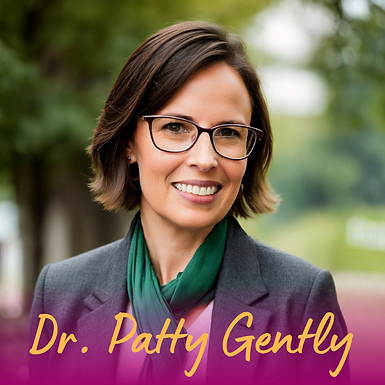
Meet your (other) host, Dr. Patty Gently! Gentle Heretic and Bright Insight founder and Information & Institutional Memory Steward, Dr. Patty Gently, is a developmental psychologist, therapeutic mentor, and author supporting gifted and neurodivergent adults. She co-founded Bright Insight Support Network in 2018. Dr. Gently is the author of Intersection of Intensity: Exploring Giftedness and Trauma (2024, Gifted Unlimited), with a second book, Hyperneuroplastic: Beyond Gifted Neurodivergence, currently in development. She is the originator of the HNP (Hyperneuroplasticity) and GEAR frameworks, drawing on nonlinear dynamical systems theory and Dąbrowski's Theory of Positive Disintegration to explore giftedness, trauma, and neurodivergence as interconnected.
